Story
Frontier Tech
Recursion
For an AI-enabled drug, the next test is a patient outcome
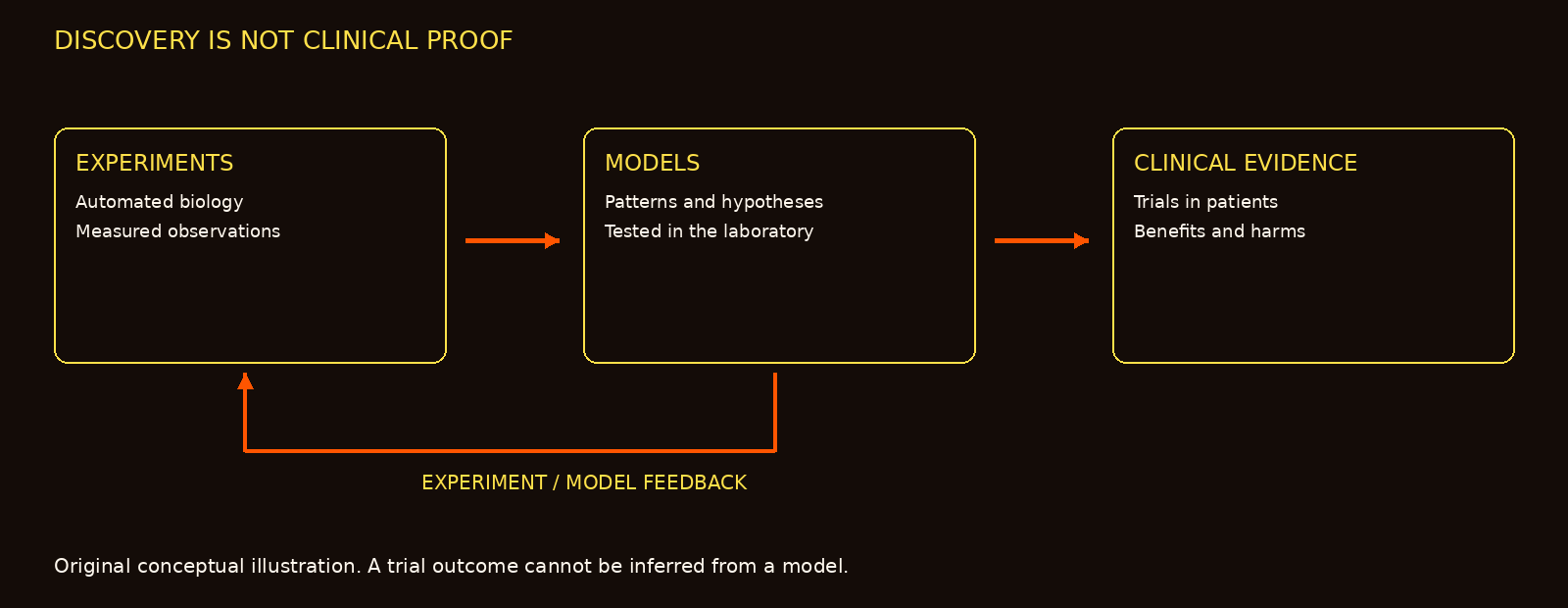
Recursion's planned FAP trial puts the emphasis on clinically meaningful events, not the size of a model or a dataset.
The question after discovery
The most informative part of Recursion's latest announcement is a measurement. Its planned Phase 3 trial of REC-4881 will count the removal of a sufficiently large adenoma as one of several events in the primary endpoint. That turns an abstract discussion about AI-enabled drug discovery into a concrete clinical question: can an investigational medicine delay events that matter in the course of a disease? [1]
On 18 November, Recursion said it had aligned with the FDA on this trial design for adults with familial adenomatous polyposis, or FAP, who have had a colectomy or proctocolectomy. It expects roughly 200 participants and a start in the second half of 2027. These remain plans. The announcement is not a drug approval or a completed Phase 3 result. [1, 2]
Why an event matters
FAP is an inherited disorder associated with the development of numerous gastrointestinal polyps. Removing the colon does not necessarily end the disease: patients may still need surveillance and procedures involving the remaining rectum, ileal pouch or upper gastrointestinal tract. The proposed study focuses on people who have already undergone that major surgery. [1, 2]
Its primary endpoint is event-free survival, measured from randomisation to the first qualifying event. The list includes removal of an adenoma at least 10 mm in either the upper or lower GI tract, prespecified criteria for FAP-related surgery, high-grade dysplasia or cancer, and death from any cause. This is a composite endpoint, combining several different events into one measure. [1]
That construction makes the individual components important. A future result should explain which events occurred and how they were distributed, rather than leaving readers with only a headline number for the composite. This is a question to bring to the eventual data, not a criticism of results that do not yet exist.
What the early data actually describe
Drug Discovery & Development reports that the November TUPELO update included a median 47% reduction in total polyp burden after 12 weeks of treatment among 15 patients. Twelve weeks after stopping treatment, 11 of 13 evaluable patients remained below their baseline polyp burden. Those denominators belong with the percentages: the data describe small groups, and not every analysis includes the same people. [2]
Safety belongs in the same account. The reporting describes four of 26 patients in the safety population having a grade 3 treatment-related adverse event, with no grade 4 or 5 treatment-related events. A reduction in polyp burden is not a complete description of a treatment's usefulness without that accompanying evidence. [2]
The existing study's ClinicalTrials.gov record lists a non-randomised, unmasked Phase 1b/2 design. The proposed Phase 3 study, by contrast, is intended to be randomised, double-blind and placebo-controlled. The two designs answer different questions with different strength. [1, 3]
Where AI enters, and where it does not settle the answer
Recursion says it used phenotypic screening and AI models to identify the drug's potential in FAP. Independent reporting traces the compound back to Takeda's TAK-733, licensed in 2020. The relevant innovation claim is about finding and developing a use, not necessarily creating a new chemical entity. [1, 2]
The programme is therefore a useful way to follow the field without turning every milestone into a verdict on AI medicine. A platform can help choose a hypothesis. Trial design specifies how that hypothesis will be tested. Only the resulting evidence can establish whether the treatment produces a worthwhile balance of benefit and harm. The next important story will be what happens in that test.
As of 19 November 2026
Published 2026-11-19