Story
Frontier Tech
Infleqtion
Thirty logical qubits, and the details that make the number useful
Infleqtion's Sqale demonstration is a hardware milestone. Understanding it means asking what was encoded, which errors were handled and how the output was measured.
Start with the experiment
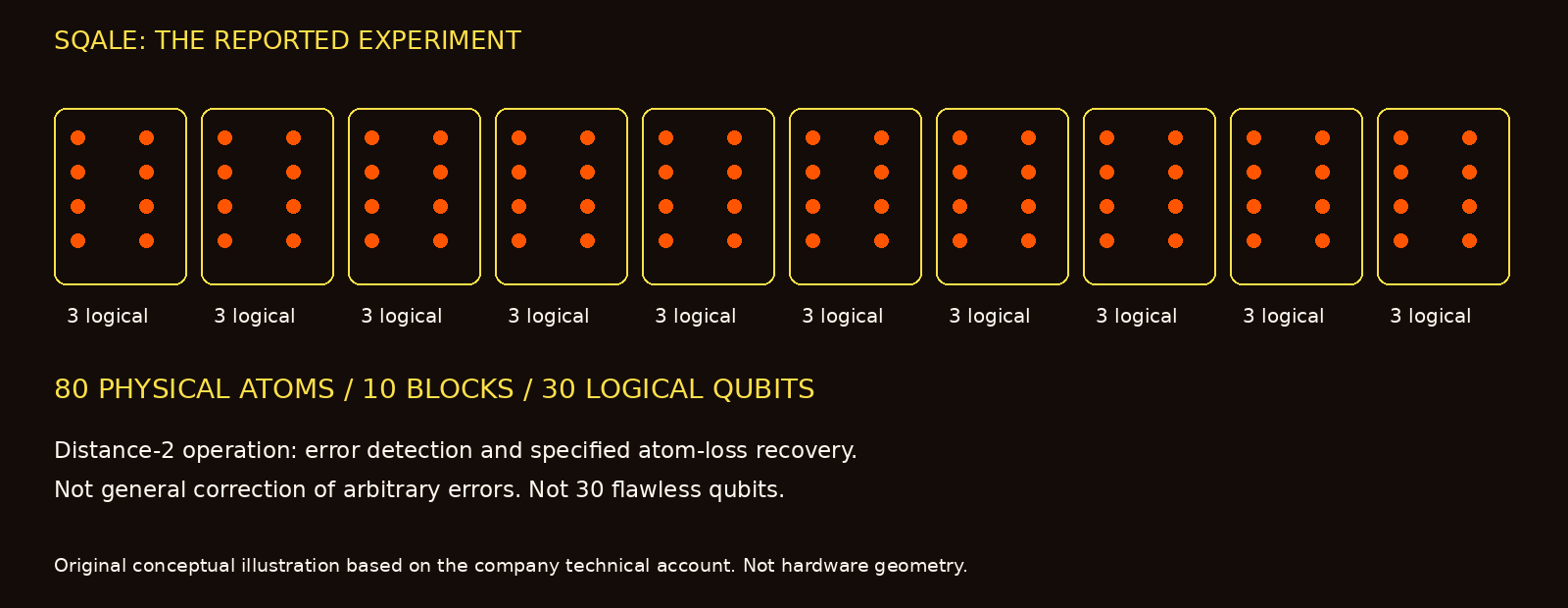
Infleqtion's November update repeated a striking number: 30 entangled logical qubits on its Sqale neutral-atom processor. The company's September technical account supplies the details that make the headline interpretable. It says the experiments were completed in August using 80 physical qubits and Superstaq software to compile circuits for hardware execution. [1, 2]
This is a report of a particular computation, not a universal score for the entire machine. Logical-qubit counts need context because different codes, circuit depths and error-handling procedures can produce numbers that are not directly comparable. The useful question is what those 30 units of encoded information actually did.
Ten blocks, not thirty flawless atoms
The team grouped the 80 atoms into ten blocks of eight, encoding three logical qubits per block. Its technical account distinguishes preparation in a distance-3 code from operation in a distance-2 code in the downstream experiment. That change matters: preparation and subsequent computation are not the same stage with the same error guarantees. [2]
Infleqtion describes the operating code as able to detect errors or correct for a lost atom. Quantum Observer's explanation draws the important boundary: distance 2 supports detection of a single arbitrary error, not guaranteed correction of one. Correcting a known missing atom through parity relationships is a more specific procedure than correcting any unknown error. [2, 3]
That does not make error detection unimportant. It means the result should be described on its own terms. Detection, loss recovery and general error correction are different achievements, not interchangeable labels for reliability.
A signal is not a speedup
The experiment ran an instantaneous quantum polynomial-time, or IQP, circuit with entangling gates connecting all 30 logical qubits. The company reports about 1,000 physical operations in total and 136 physical two-qubit gates. Those physical-operation counts should not be rewritten as 1,000 reliable logical operations. [2]
In the company's account, an ideal circuit can produce 262,144 of the more than one billion possible 30-bit outputs. It reports an approximately 25% hit fraction in that permitted set, roughly 1,000 times the uniform-random baseline. That comparison concerns the distribution of measured outputs. It is not a claim that the computer runs a useful application 1,000 times faster than a classical machine. [2]
Nor should that hit fraction be relabelled as overall circuit fidelity. Quantum.world reports separate circuit-level fidelity and yield figures from the November presentation. Different measurements answer different questions; combining the most attractive number from each would create a result the source never reported. [4]
More outputs can come with a trade-off
Infleqtion says post-processing for a block with a lost atom let it reconstruct a missing measurement outcome. Applying that loss correction quadrupled its number of good shots in the technical account, while increasing error rates. This is a throughput-versus-accuracy trade-off, not a free improvement to every measure. [2]
The company lists real-time control and mid-circuit measurement among its priorities for moving beyond post-selection. These are steps towards finding and handling errors during a computation, rather than relying only on which completed runs are retained. The public roadmap is an account of work still to do. [2, 3]
The right-sized conclusion
The meaningful result is a connected, encoded computation on neutral-atom hardware with an explicit account of its code and some of its limitations. It is worth following without declaring that useful, fault-tolerant quantum computing has arrived. [2]
Future reports become more informative when they disclose the circuit, accepted and discarded runs, logical error behaviour and full resource cost together. A larger logical-qubit number will matter most when it comes with evidence that the machine can sustain longer and more reliable computations. The number opens the discussion. The operating details decide what it means.
As of 19 November 2026
Published 2026-11-19