Story
Frontier Tech
Google / Blue Origin
Google books a bigger ride for its AI-in-orbit experiment
Blue Origin's New Glenn is targeted to carry Project Suncatcher satellites in early 2029. A launch agreement is a milestone, not a working orbital cloud.
Google's plan to explore AI computing in space has a new launch partner. On 19 November, Google and Blue Origin announced an agreement for Project Suncatcher's first dedicated heavy-lift launch, targeted for the first quarter of 2029.
What is planned
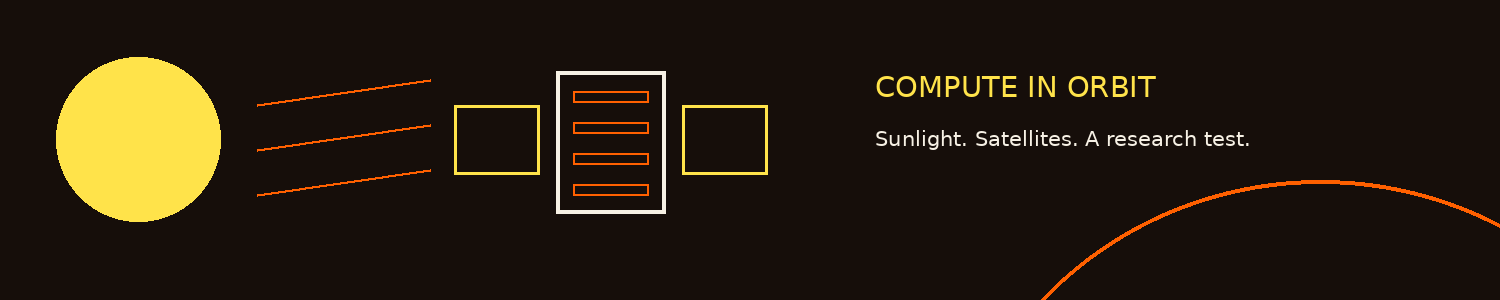
New Glenn is intended to deploy satellites into sun-synchronous orbit. The companies describe each satellite's computing capacity as roughly the scale of a data centre rack. Blue Origin says the project explores a network of solar-powered satellites carrying Google's Tensor Processing Units, the company's AI chips.
The signal
The interesting shift is from an idea about abundant sunlight to a named launch vehicle and target window. That makes the next stage easier to follow. There is a partner, an intended orbit and a rough unit of computing capacity. None of those details, however, tells us the eventual cost of useful computing delivered from space.
Keep the scale honest
A rack-scale satellite is not the same thing as a complete terrestrial data centre. The announcements do not state the number of satellites on this mission, the contract price or a commercial service date. They also do not establish that orbital computing can beat ground-based infrastructure on cost, reliability or deployment speed. Google itself describes Suncatcher as a long-term moonshot.
What to watch
Follow the target date, disclosed payload details and evidence from the computing systems once deployed. The questions are practical: what work runs, how consistently it runs and what it costs to deliver the result. Those are the measures that would turn a compelling launch story into an infrastructure story. For now, the agreement gives a research programme a larger planned ride. It is not an announcement that Google's AI business is moving off Earth.
As of 19 November 2026
Published 2026-11-19