Story
Frontier Tech
Cohu
Before an AI chip goes to work, it has to pass the heat test
Cohu's latest Eclipse selection explains why moving, cooling and contacting a processor are part of the computing story.
The factory behind the processor
An AI processor is usually introduced through what it can calculate. A production test system has a different question: does this particular device behave as required under the conditions being measured? Cohu's November announcement puts the machinery around that question in view. [1, 4]
On 10 November, the company said a new fabless semiconductor customer had chosen its Eclipse handler for next-generation high-performance computing devices. Testing is to take place at an Asian facility operated by an outsourced semiconductor assembly and test provider, or OSAT. Cohu described it as Eclipse's fourth HPC customer qualification. The names of both companies were withheld, so the release should not be converted into a story about an assumed chip designer. [4]
A handler is not the whole tester
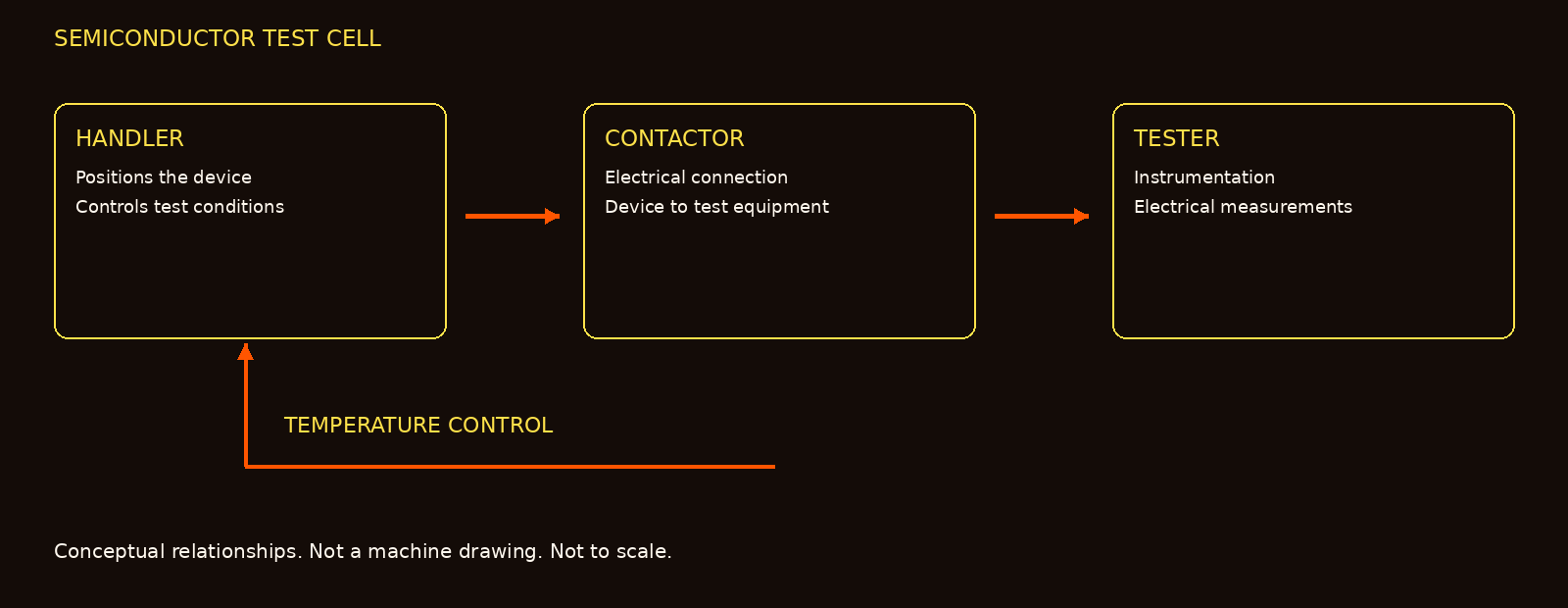
The word test can conceal several machines and jobs. Cohu describes handlers that move devices, control temperature and provide vision inspection. Testers contain the instrumentation used for electrical measurements. Contactors connect the semiconductor device to the tester. Each part has to work with the others, but a new handler selection does not by itself identify the electrical tester or the full production-line design. [1]
That division is useful for understanding Eclipse. Cohu presents it as a field-upgradable handler platform for processors including CPUs, GPUs, network processors and custom AI accelerators. Its job is to support production testing, not to create the chip's architecture or prove that a particular AI model runs well on it. [4]
Heat belongs inside the measurement
Thermal control is central to the platform's stated purpose. Cohu says T-Core actively manages temperature to support repeatable testing of high-performance devices. This is a measurement problem as well as an equipment problem: a test result is more useful when the conditions under which it was obtained are controlled. The company describes precise, uniform thermal control as a requirement of the November production selection. [3, 4]
The documentation also shows why specifications need a date and a configuration. The September 2025 announcement described up to 3 kW of power dissipation. A product sheet revised in March 2026 describes 6 kW T-Core X capability in newer configurations, with separate specifications for Eclipse and EclipseX. The later figure is not a reason to rewrite what the earlier installed system could do. [2, 3]
Do not multiply the headline numbers
The March sheet lists throughput of up to 12,000 units per hour and multiple parallel-test configurations. It also lists different package sizes, force limits and thermal options. These are a menu of vendor specifications. The document does not establish that the highest throughput, largest package, most parallel sites and maximum thermal load are achieved together on one production workload. [2]
That is the gap between a product specification and a factory result. To judge a deployed system, useful questions would include the tested device, temperature stability, test duration, contact reliability and sustained throughput. The public November announcement does not provide that complete operating record. It reports a selection and intended production use. [4]
Software around the machine
Cohu says the Eclipse systems in the new selection ship with PAICe Prescriptive software, which analyses equipment signals and behaviour patterns to improve productivity. This is a stated purpose of the software, not an independently measured improvement for the unnamed customer's line. No customer-specific before-and-after dataset accompanies the release. [4]
The broader story is practical. Advanced computing depends on more than processor design: production equipment must make high-volume testing repeatable. Cohu's announcement is a useful window into that infrastructure. It is also a reminder to keep a machine's advertised capability, a customer's qualification and a measured production outcome as three separate kinds of evidence.
As of 19 November 2026
Published 2026-11-19
Sources
- 1. Cohu product and company overview, Accessed 19 November 2026
- 2. Eclipse platform product sheet, revision 20260310, 10 March 2026 revision
- 3. Cohu Eclipse platform chosen for next-generation AI computing devices, 18 September 2025
- 4. Eclipse selected for production test of next-generation HPC devices, 10 November 2026