Story
Frontier Tech
Butterfly Network / Bridge Neurotech
Ultrasound can image the body. Reading the brain is a different test
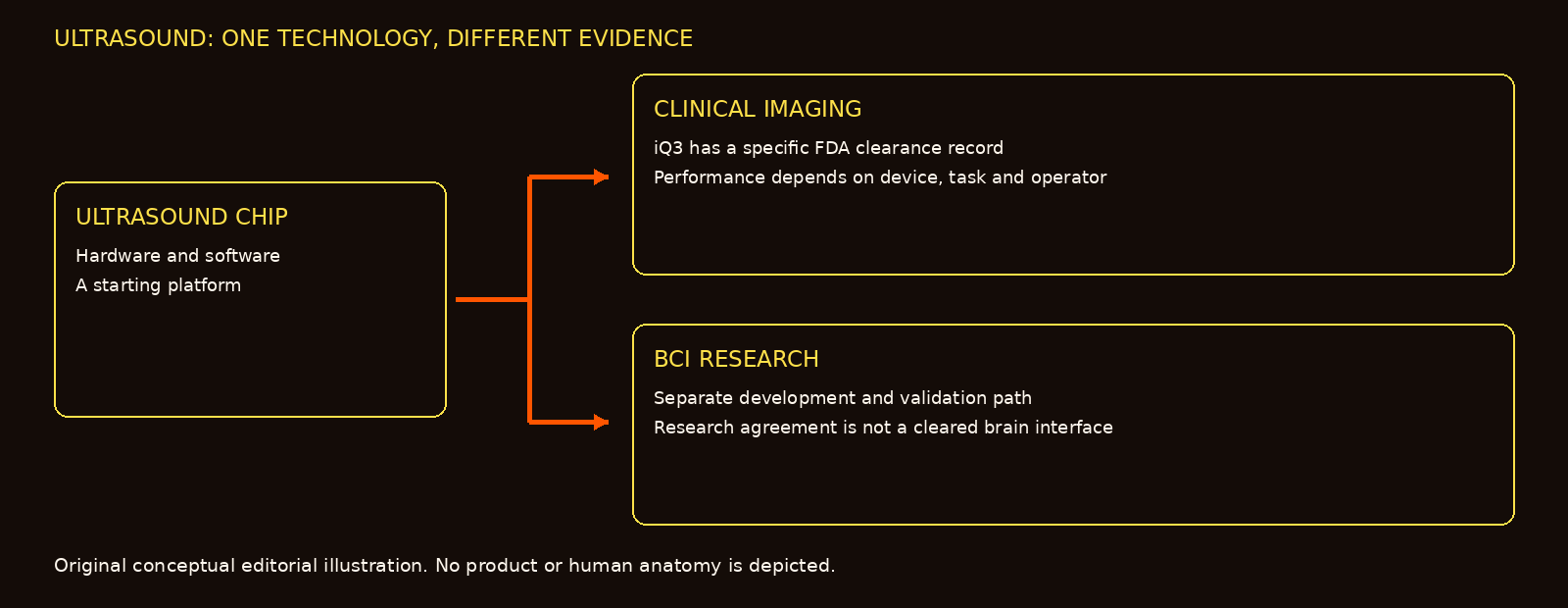
Butterfly's partnership with Bridge Neurotech opens a research path, not a shortcut from a handheld scanner to a proven brain-computer interface.
An agreement, not a finished interface
On 6 October 2026, Butterfly Network and Bridge Neurotech announced a research and development agreement to explore a fully non-invasive brain-computer interface. Bridge will license Butterfly's programmable ultrasound technology. The multi-year arrangement includes technology-access payments, development milestones and commitments to purchase hardware. [3]
That describes a development relationship. It does not demonstrate that a wearable system can reliably decode a person's intended action through an intact skull, and it does not announce clinical clearance for such a system. The distinction is the centre of the story, not a footnote to it.
What the signal would mean
MassDevice's reporting describes Bridge's approach as tracking changes in oxygenated blood flow associated with active neurons, then using those measurements as a proxy for intended thoughts or actions. A proxy is an indirect signal: the system must infer something about neural activity rather than simply reading a sentence out of the brain. [4]
Bridge describes its platform as functional ultrasound imaging combined with AI-based neural decoding. The founders' case is that advances in ultrasound chips, processing and decoding models make a non-surgical approach worth pursuing. That is the company's research thesis, not a result that the October announcement proves. [3, 6]
The skull is part of the problem
In his October founder's letter, Bridge CEO Will Biederman says the skull scatters and absorbs sound differently in different people. He also distinguishes prior human functional-ultrasound work through openings in the skull from the company's goal of imaging non-invasively. Those conditions should not be collapsed into one achievement. [6]
The same letter says its first study is enrolling healthy adults as well as adults who have had cranioplasty with PEEK or Longeviti implants. Recruiting those groups is not itself a report of successful decoding. It does show why readers need to ask which participants and which skull conditions support any future result. [6]
A cleared probe is not a cleared BCI
Butterfly has already brought ultrasound hardware into clinical imaging. The FDA database lists a substantially-equivalent decision for its iQ3 Ultrasound System dated 4 January 2024. That record is specific to the device and its cleared use. It is not clearance of Bridge's proposed brain interface. [1, 2]
Nor is the existence of an image enough to establish a useful interface. A convincing future report would need to explain the task, participants, training procedure, decoding accuracy, response time and how performance changes outside the training session. These are questions for evaluating evidence, not claims that Bridge has already supplied those results.
What an older clinical study can, and cannot, tell us
A 2024 study offers a grounded example of why application-specific validation matters. In 21 emergency-department patients, researchers compared bladder-volume measurements from the earlier Butterfly iQ, a cart-based ultrasound and a conventional bladder scanner against catheterisation. The authors found the cart-based system had the highest agreement with the reference measurement, while the handheld iQ and bladder scanner were rated more convenient. [5]
The study was small, came from one medical-centre system and was predominantly male. It examined bladder assessment with an earlier device, not iQ3 and certainly not brain decoding. Its relevance is methodological: portability, convenience and measurement accuracy are different questions, and a finding in one task cannot be stretched to cover another. [5]
The useful frontier is the unanswered question
For Butterfly, Embedded gives other developers a way to build with its ultrasound technology. For Bridge, that hardware is a starting point for a difficult sensing and decoding problem. The public should be able to follow both ideas without being asked to treat a research partnership as a working medical product. [3, 4]
The next meaningful step is a report that makes its conditions and limits clear. Until then, the accurate description is straightforward: an ultrasound-based route to a non-invasive brain-computer interface is being researched. A route is not yet a destination.
As of 19 November 2026
Published 2026-11-19
Sources
- 1. FDA clearance announcement for Butterfly iQ3, 8 January 2024
- 2. 510(k) K232808: Butterfly iQ3 Ultrasound System, Decision 4 January 2024
- 3. Bridge Neurotech and Butterfly research partnership, 6 October 2026
- 4. Butterfly Network to chase ultrasound BCI with Bridge Neurotech, 8 October 2026
- 5. Handheld Ultrasound Bladder Volume Assessment Compared to Standard Technique, 16 July 2024
- 6. A letter from the founder, October 2026