Company
Frontier Tech
Recursion
Recursion: connecting automated biology with drug development
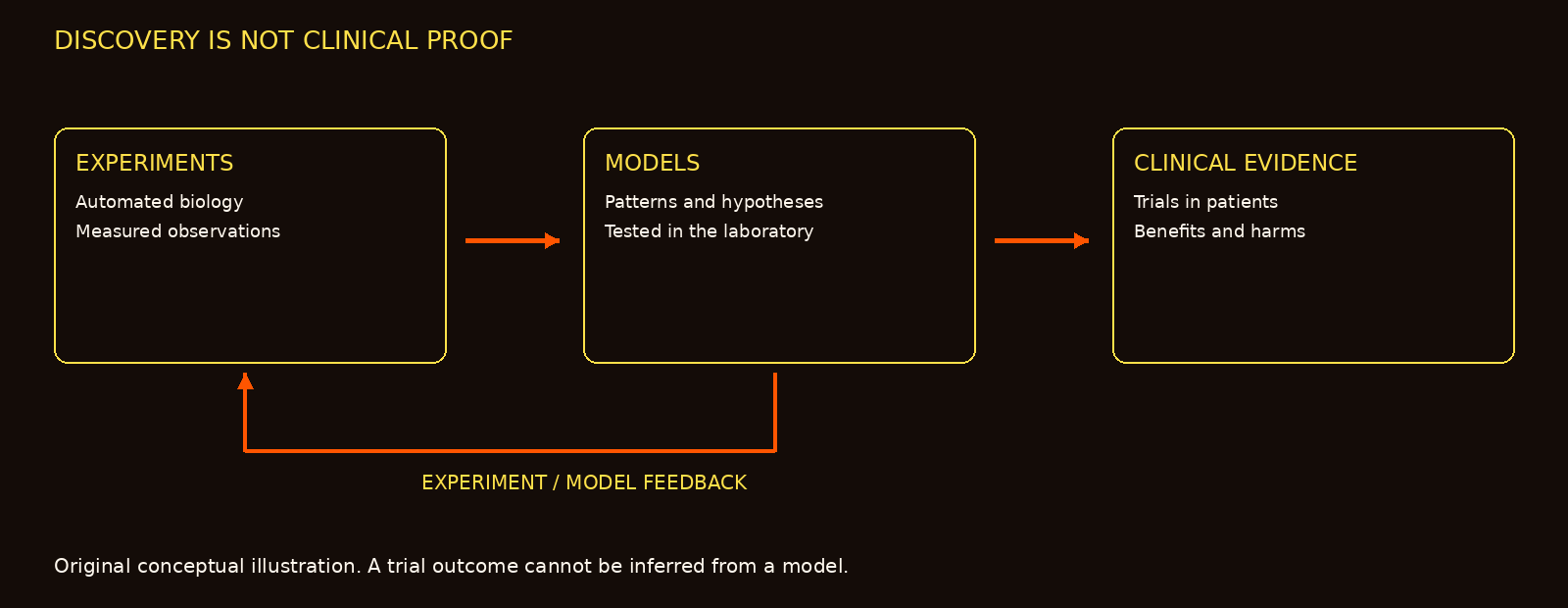
The company combines laboratory experiments, data and AI models. Its medicines still have to pass clinical trials.
What the company does
Recursion is a clinical-stage drug discovery and development company founded on 5 November 2013 by Blake Borgeson, Chris Gibson and Dean Li. Its current president and chief executive is Najat Khan. The company's public description centres on combining biology, chemistry and computation rather than treating drug discovery as a software-only problem. [1, 2]
Its Recursion OS platform integrates laboratory-generated data, AI models and scientific teams. Recursion says its automated biology and chemistry laboratories in Salt Lake City and Milton Park, Oxfordshire, produce proprietary data for this work. The platform is a way to generate and test hypotheses. Whether a resulting medicine helps patients is a separate question. [2]
How to read the pipeline
Recursion develops investigational medicines internally and through partnerships. Its public pipeline lists REC-4881, an oral MEK1/2 inhibitor being studied in familial adenomatous polyposis, or FAP, and REC-1245, an RBM39 degrader being studied in solid tumours and lymphoma. They are development programmes, not established treatments for those uses. [3]
REC-4881 illustrates the difference between discovery and clinical development. Recursion says phenotypic screening helped identify its potential in FAP. The compound was originally developed by Takeda as TAK-733 and licensed by Recursion in 2020, according to Drug Discovery & Development. Describing that story as an AI system inventing a new molecule from nothing would erase an important part of its history. [2, 4]
A current milestone
On 18 November 2026, Recursion announced FDA alignment on the design of a planned Phase 3 REC-4881 trial. The company expects about 200 adults with FAP who have already had colon-removal surgery to participate, with a start targeted for the second half of 2027. Design alignment is not approval of the drug, evidence that the trial has started or a guarantee of success. [2]
The existing TUPELO study remains a Phase 1b/2 programme. ClinicalTrials.gov lists it as recruiting under NCT05552755, with an estimated enrolment of 67 and a non-randomised, unmasked design. These are the existing study's registry characteristics, not the proposed Phase 3 design. [5]
What would demonstrate progress
Useful evidence includes well-described clinical populations, prespecified endpoints, appropriate comparisons and a clear account of harms as well as benefits. Faster laboratory work can be valuable, but it does not remove those requirements. Recursion's public story is the attempt to connect an industrialised discovery process with medicines that can prove their value in patients.
As of 19 November 2026
Published 2026-11-19