Company
Frontier Tech
Infleqtion
Infleqtion: computing and measurement built around atoms
A guide to the company's neutral-atom computers, precision sensors and quantum software, and the distinctions between them.
More than one quantum product
Infleqtion develops neutral-atom quantum computers, sensing systems and software. Its product categories include quantum optical clocks, radio-frequency receivers and inertial sensors as well as computing. A clock that measures time and a processor that runs a quantum circuit may share an atomic-physics foundation, but they are different instruments with different performance tests. [1, 2]
The company identifies Dana Anderson as its founder and chief science officer, Matt Kinsella as chief executive and Pranav Gokhale as chief technology officer. Its software platform, Superstaq, connects the description of a quantum computation with the operations performed on hardware. [1, 3]
Physical and logical qubits
In a neutral-atom computer, atoms provide the physical qubits. A logical qubit is encoded information spread across physical qubits, using a code that can help detect or correct particular errors. The word logical is not a promise that errors have disappeared, and the number of logical qubits is not meaningful without the code and experiment that define it. [3, 4]
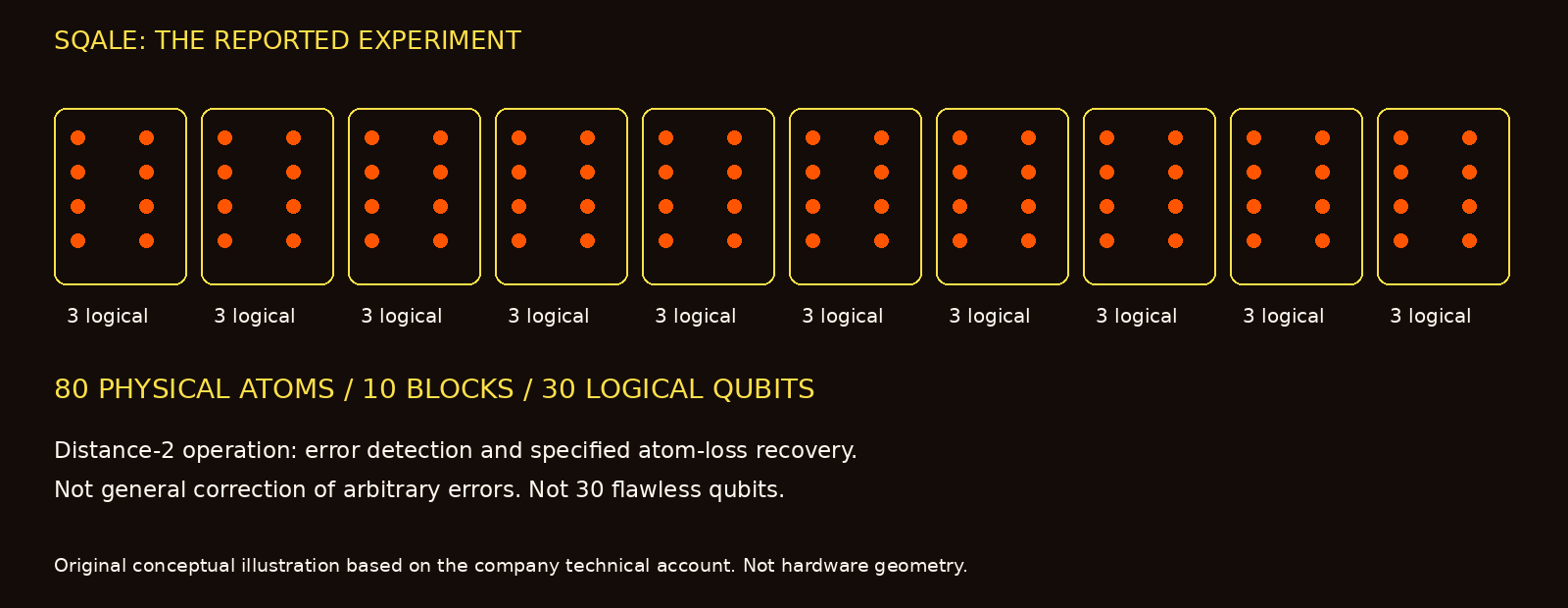
Infleqtion's September 2026 technical account describes 80 physical qubits grouped into ten blocks of eight, each encoding three logical qubits. That gives 30 logical qubits for the reported experiment. The company says the downstream computation uses a distance-2 code that supports error detection and recovery from a lost atom in the stated conditions. This is narrower than general correction of arbitrary errors. [3]
What the milestone shows
The demonstration used an IQP circuit with entangling operations spanning the 30 logical qubits and about 1,000 physical quantum operations. It is a specific hardware experiment, not a claim that 30 perfect qubits can run any application for an unlimited time. Infleqtion reiterated the milestone in its November update. [2, 3]
The same technical account names real-time control and mid-circuit measurement as priorities for moving beyond post-selection. Its target of 100 logical qubits in 2028 is a roadmap goal, not an already delivered machine. [3]
A useful way to follow the company
For sensing, the question is what an instrument measures and how it performs under real operating conditions. For computing, it is what circuit ran, which errors were managed and what resources and output quality were required. Keeping those questions separate makes Infleqtion easier to understand than treating every atomic device as the same kind of quantum breakthrough.
As of 19 November 2026
Published 2026-11-19