Company
Frontier Tech
Cohu
Cohu: the machinery that checks the chip
A guide to the test equipment, temperature control, electrical contacts and inspection systems behind semiconductor production.
What it does
Cohu supplies equipment, software and services used to test and inspect semiconductors. Founded in 1947, it operates in a part of chip production that is easy to overlook: moving devices into position, making an electrical connection, controlling the test environment and checking the result. Its products serve applications including computing, automotive electronics, industrial systems and connectivity. [1]
It is not a designer of the AI processors that run a model, nor a foundry manufacturing their transistors. It supplies tools used to establish whether semiconductor devices meet the requirements set for them. That distinction places it in manufacturing infrastructure rather than the consumer-facing layer of technology. [1]
The parts of the test cell
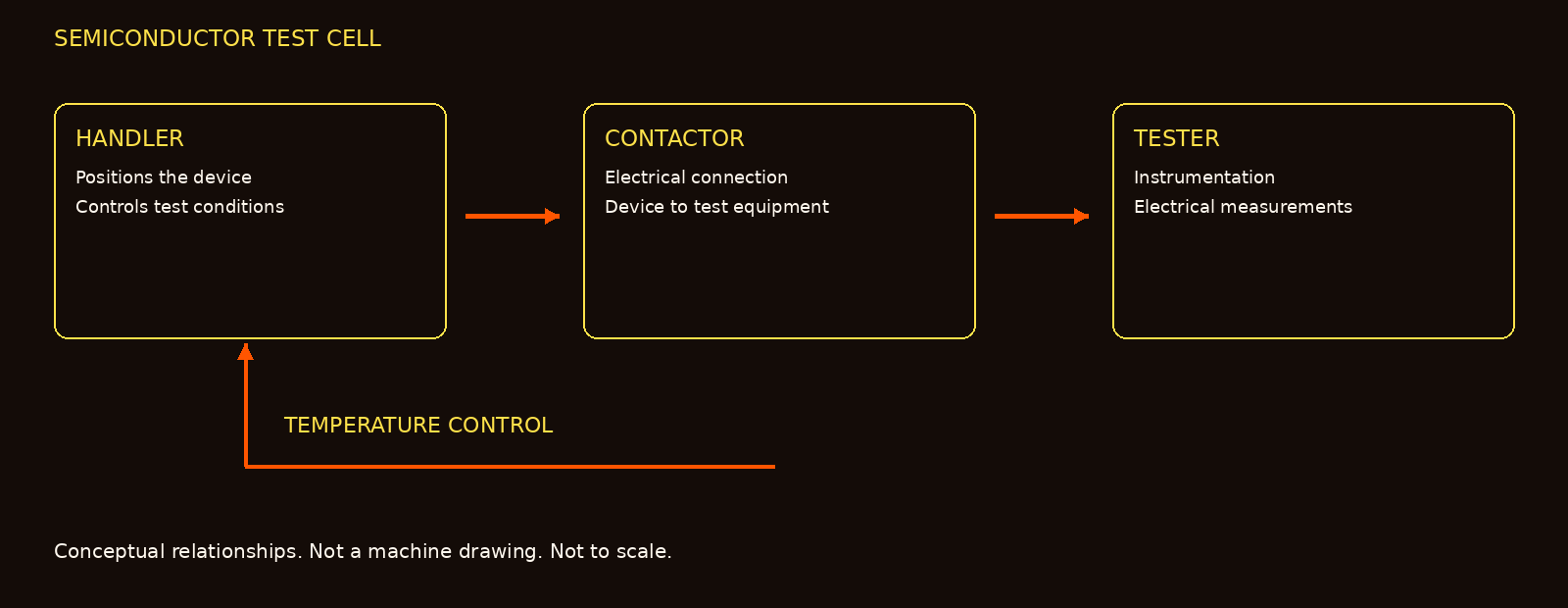
A handler automates the movement of devices and can manage their temperature during testing. A tester supplies instrumentation for electrical measurements. A contactor is the interface connecting the device to that equipment. Inspection and metrology systems examine quality and measure features, while software analytics helps a manufacturer interpret equipment and process information. Cohu sells products across these different jobs; they are related, but they are not interchangeable. [1]
Its Eclipse handler platform is one example. Cohu describes a modular system that can be configured for different devices and upgraded as requirements change. The company's March 2026 product sheet distinguishes Eclipse from EclipseX and lists different package sizes, test forces and parallel-test configurations. Specifications belong to a particular configuration, not every machine carrying the family name. [2]
Why temperature matters
Cohu's T-Core active thermal-control technology is intended to keep a device within a controlled temperature range during test. Its September 2025 Eclipse announcement described up to 3 kW of power dissipation. A newer March 2026 product sheet describes configurations with 6 kW capability. These are dated vendor specifications, not evidence that every installed system has the newer capability or achieves the same production throughput. [2, 3]
A recent milestone
On 10 November 2026, Cohu said a new fabless semiconductor customer had selected Eclipse for production testing of high-performance computing devices at an outsourced assembly and test facility in Asia. It called this the fourth customer to qualify Eclipse for HPC applications. Neither the chip designer nor the test provider was named. The announcement establishes a company-reported selection, not the identity of a particular processor programme. [4]
Cohu's role is best understood through the work its tools perform: repeatable contact, controlled temperature, useful measurements and efficient movement through production. Claims about faster testing or higher yield still need evidence from the relevant device, configuration and factory.
As of 19 November 2026
Published 2026-11-19
Sources
- 1. Cohu product and company overview, Accessed 19 November 2026
- 2. Eclipse platform product sheet, revision 20260310, 10 March 2026 revision
- 3. Cohu Eclipse platform chosen for next-generation AI computing devices, 18 September 2025
- 4. Eclipse selected for production test of next-generation HPC devices, 10 November 2026